
目录
| # | 曲目 | 时长 |
|---|---|---|
1 | Harmonische Freude musicalischer Freunde Seine Not recht überlegen, Wird manch Tränen-Bad erregen | 00:08:03 |
| 2 | Harmonische Freude musicalischer Freunde Des Tadlers Stich, Verlache ich | 00:06:24 |
| 3 | Harmonische Freude musicalischer Freunde Liebe in Abwesenheit, Grünet durch Beständigkeit | 00:10:00 |
| 4 | Sonata quinta I. Adagio – Allegro – Adagio | 00:02:08 |
| 5 | Sonata quinta II. Allemande | 00:02:18 |
| 6 | Sonata quinta III. Courante | 00:01:07 |
| 7 | Sonata quinta IV. Sarabande – Variatio | 00:02:45 |
| 8 | Sonata quinta V. Gigue | 00:01:07 |
| 9 | Harmonische Freude musicalischer Freunde Wer sich dem Himmel übergeben, Wird endlich Ruh’ und Glück erleben | 00:05:45 |
| 10 | Harmonische Freude musicalischer Freunde An Jammer und Beschwerlichkeit, da fehlt es hier zu keiner Zeit | 00:07:37 |
| 11 | Harmonische Freude musicalischer Freunde Auf des Kreuzes Finsternis, folgt die Sonne ganz gewiß | 00:03:14 |
| 12 | Sonata seconda I. Adagio | 00:01:32 |
| 13 | Sonata seconda II. Allegro | 00:01:10 |
| 14 | Sonata seconda III. Adagio | 00:01:08 |
| 15 | Sonata seconda IV. Allemande | 00:01:16 |
| 16 | Sonata seconda V. Courante | 00:01:04 |
| 17 | Sonata seconda VI. Sarabande – Variatio | 00:02:51 |
| 18 | Sonata seconda VII. Gigue | 00:01:25 |
| 19 | Harmonische Freude musicalischer Freunde Ich finde schlechte Freud, bei Unempfindlichkeit | 00:04:08 |
| 20 | Harmonische Freude musicalischer Freunde Die Zeit verkehret, was uns beschweret | 00:05:49 |
专辑简介
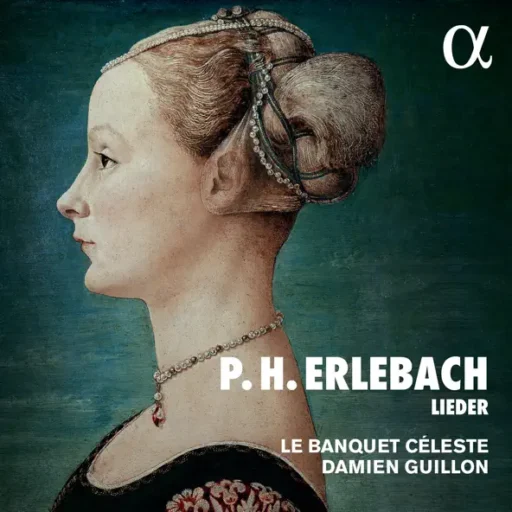
Accompanied by his ensemble Le Banquet Céleste, the counter-tenor Damien Guillon put his voice at the service of a program dedicated to vocal pieces by the German Baroque composer Philipp Heinrich Erlebach, whose production was largely destroyed during the burning of Rudolstadt Castle in 1735. Among the works that have come to us are the two collections Harmonische Freude musikalischer Freunde, which bring together in two parts 50 and 25 arias for 1, 2, 3 or 4 solo voices, an instrumental ensemble and a continuo. Most of the lyrics, written in Old German, shows man at the mercy of an unpredictable and volatile fate. Alongside natural phenomena such as storms, dark clouds, faded leaves, the poet also chooses as a metaphor for torment and “the distress of the heart” the expression “bloody comets”. In fact, the largest comet of the seventeenth century appeared in Europe in 1680: men at that time apprehended these celestial bodies, seeing in them bad omens…
- 解压文件(rar/zip/7z等)图文教程: https://www.4kstar.net/uncompress