

目录
| # | 曲目 | 时长 |
|---|---|---|
1 | Herr Jesu Christ, dich zu uns wend (Georg Böhm): Variation I | 00:01:50 |
| 2 | Livre d’orgue II, Suite dans le premier ton (Jacques Boyvin): No. 5, Récit tendre | 00:02:45 |
| 3 | Ecce quam bonum, Motet à voix seule et deux dessus de violons (André Campra): I. Ecce quam bonum | 00:02:11 |
| 4 | Ecce quam bonum, Motet à voix seule et deux dessus de violons (André Campra): II. Quoniam illic mandavit Dominum | 00:01:42 |
| 5 | Entrée de la Gloire et de la Sagesse d’Armide (from Armide, LWV 71) (Jean-Baptiste Lully) [Transcr. for Harpsichord by Anonymous] | 00:02:31 |
| 6 | Sonata a 2 (Anonymous): I. | 00:01:07 |
| 7 | Sonata a 2 (Anonymous): II. | 00:01:01 |
| 8 | Sonata a 2 (Anonymous): III. | 00:01:05 |
| 9 | Sonata a 2 (Anonymous): IV. Allemanda | 00:01:39 |
| 10 | Sonata a 2 (Anonymous): V. Courant | 00:01:01 |
| 11 | Sonata a 2 (Anonymous): VI. Ballet | 00:00:39 |
| 12 | Sonata a 2 (Anonymous): VII. Sarabande | 00:01:15 |
| 13 | Sonata a 2 (Anonymous): VIII. Gigue | 00:01:07 |
| 14 | Surgite cum gaudio a 3 (Johann Philipp Krieger): I. Sonate, Surgite Cherubim | 00:03:29 |
| 15 | Surgite cum gaudio a 3 (Johann Philipp Krieger): II. Jesus Christus Rex triumphat | 00:01:10 |
| 16 | Surgite cum gaudio a 3 (Johann Philipp Krieger): III. Hunc Dei filium | 00:03:41 |
| 17 | Surgite cum gaudio a 3 (Johann Philipp Krieger): IV. Quia de morte di Satana, Alleluja | 00:01:46 |
| 18 | Entrée d’Apollon (from Le triomphe de l’amour, LWV 59) (Jean-Baptiste Lully) [Transcr. for Viola da Gamba by Anonymous] | 00:02:28 |
| 19 | Ballet des Arts, LWV 18 (Jean-Baptiste Lully): Duo de la Paix et de la Félicité | 00:04:52 |
| 20 | Suite en trio (Johann Caspar Ferdinand Fischer): I. Allemande | 00:01:43 |
| 21 | Suite en trio (Johann Caspar Ferdinand Fischer): II. Angloisse | 00:00:57 |
| 22 | Suite en trio (Johann Caspar Ferdinand Fischer): III. Gique | 00:00:53 |
| 23 | Suite en trio (Johann Caspar Ferdinand Fischer): IV. Menuets | 00:02:34 |
| 24 | Suite en trio (Johann Caspar Ferdinand Fischer): V. Ballets | 00:00:45 |
| 25 | Sourdine d’Armide (from Armide, LWV 71) (Jean-Baptiste Lully) [Transcr. for Harpsichord by Anonymous] | 00:03:03 |
| 26 | Plainte de Cloris (from Le Grand Divertissement royal de Versailles) (Jean-Baptiste Lully) | 00:05:06 |
| 27 | Tranquilles Cœurs. Ritornelle (from Le triomphe de l’amour, LWV 59) (Jean-Baptiste Lully) [Transcr. for Viola da Gamba by Anonymous] | 00:01:47 |
| 28 | Tranquilles Cœurs (from Le triomphe de l’amour, LWV 59) (Jean-Baptiste Lully) | 00:02:38 |
| 29 | Aria in F Major, BWV 587 (Johann Sebastian Bach) | 00:03:45 |
专辑简介
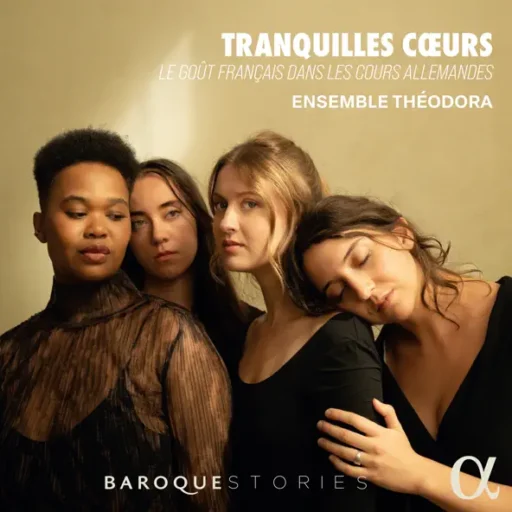
In 2018, four friends studying at the Royal Academy of Music in London decided to form an ensemble they called Théodora. Mariamielle Lamagat (soprano), Louise Ayrton (baroque violin), Lucie Chabard (harpsichord) and Alice Trocellier (viola da gamba) explore French baroque music and its ramifications. For their first recording, part of Alpha Classics\’ \”Baroque Stories\” series, they decided to trace the French style in Germanic lands in the 18th century, where the dance forms, dotted rhythms, modulations and harmonies in vogue at the court of Louis XIV inspired composers to create numerous transcriptions, works and new instrumental practices… Johann Fischer and Johann Philipp Krieger make no secret of their admiration for Campra and Lully, whose music enjoyed considerable success across the Rhine.
This programme features their magnificent ‘Duo de la paix et de la félicité’ (Duet of Peace and Happiness), in a version preserved in Berlin, performed here with mezzo-soprano Adèle Charvet… Bach is, of course, included: he admired the French organ school, particularly Jacques Boyvin, whose superb Récit tendre, from the Second Livre d\’Orgue (1700), Théodora has transcribed for violin, viola and basso continuo.

