
目录
| # | 曲目 | 时长 |
|---|---|---|
1 | Symphony No. 6 in D Major, Op. 146 – I. Larghetto con moto – Allegro | 00:10:04 |
| 2 | Symphony No. 6 in D Major, Op. 146 – II. Menuetto. Moderato | 00:04:41 |
| 3 | Symphony No. 6 in D Major, Op. 146 – III. Larghetto con moto | 00:07:34 |
| 4 | Symphony No. 6 in D Major, Op. 146 – IV. Finale. Allegro con brio | 00:08:35 |
| 5 | Symphony No. 7 in A Minor, Op. 181 – I. Allegro con spirito | 00:09:59 |
| 6 | Symphony No. 7 in A Minor, Op. 181 – II. Larghetto con moto | 00:07:56 |
| 7 | Symphony No. 7 in A Minor, Op. 181 – III. Scherzo. Allegro non troppo | 00:05:02 |
| 8 | Symphony No. 7 in A Minor, Op. 181 – IV. Introduzione. Largo – Finale. Allegro vivace | 00:09:21 |
专辑简介
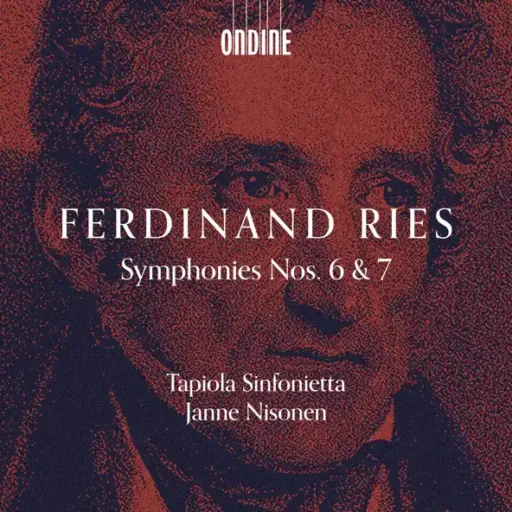
The final volume in a new groundbreaking and much-praised complete symphony cycle of Ferdinand Ries’ (1784–1838) symphonies by the Tapiola Sinfonietta and conductor Janne Nisonen includes the composer’s two final statements in the symphony genre.
Like most of his symphonies, also Ries’ Symphony No. 6 was premiered in London in 1822. His 7th Symphony, written a decade later, remained in the shadows and was published only in 2004. Both works, however, are full of discoveries. Ries’ 6th Symphony proved to be the most popular of his symphonies, receiving performances in Düsseldorf and Leipzig in 1826, followed by Berlin (1827), Kassel (1828), a possible performance at the Paris Conservatoire in 1829 and further performances in London and Dublin in 1831. Based on contemporary reviews, it was considered that in this work Ries was “adopting a rather more lively style of composition: there is a new openness and freedom of melody”. While there is a great deal to admire in this symphony on a compositional level, it owed its popular success to Ries’ gift of writing attractive, memorable themes, thrilling, powerful passages to rival even those of Beethoven in their display of furious, concentrated energy, and the whole masterfully orchestrated. Every movement in this work has striking moments. The experience of conducting the German première of Beethoven’s Ninth was almost certainly the inspiration for Ries to add ‘Turkish music’ and two piccolos to the instrumentation and no doubt contributed a good deal to the impact the work.
Ries’ final completed symphony, Symphony No. 7, written for a society in Vienna more than a decade after Symphony No. 6, remained unpublished until 2004. This work exhibits a number of stylistic changes from Ries’ earlier works, not least of all in his treatment of the orchestra. The composer took great pride in this work, although, sadly, it is not documented that this symphony would have ever been performed during the composer’s lifetime.