

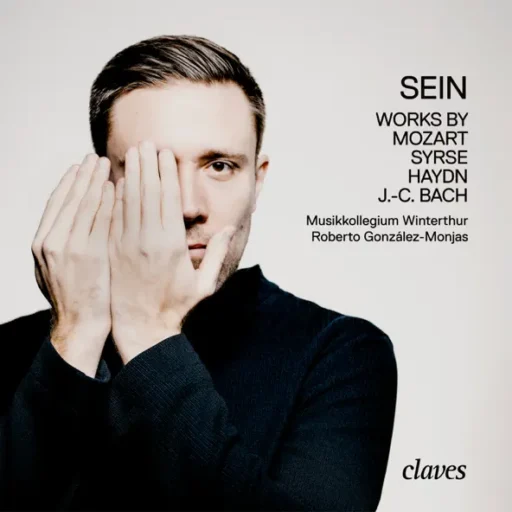
目录
| # | 曲目 | 时长 |
|---|---|---|
1 | Symphony No. 40 in G Minor, K. 550: I. Allegro moderato Wolfgang Amadeus Mozart | 00:06:36 |
2 | Symphony No. 40 in G Minor, K. 550: II. Andante Mozart | 00:11:52 |
3 | Symphony No. 40 in G Minor, K. 550: III. Menuetto Mozart | 00:04:07 |
4 | Symphony No. 40 in G Minor, K. 550: IV. Allegro assai Mozart | 00:06:49 |
5 | Quetzalcóatl for Orchestra Diana Syrse | 00:13:01 |
6 | Symphony No. 49 in F Minor, Hob. I:49 “La passione”: I. Adagio Joseph Haydn | 00:10:15 |
7 | Symphony No. 49 in F Minor, Hob. I:49 “La passione”: II. Allegro di molto Haydn | 00:06:33 |
8 | Symphony No. 49 in F Minor, Hob. I:49 “La passione”: III. Minuet Haydn | 00:05:01 |
9 | Symphony No. 49 in F Minor, Hob. I:49 “La passione”: IV. Finale. Presto Haydn | 00:03:22 |
10 | 6 Symphonies, Op. 6: No. 6 in G Minor: I. Allegro Johann Christian Bach | 00:03:16 |
11 | 6 Symphonies, Op. 6: No. 6 in G Minor: II. Andante più tosto Adagio J. C. Bach | 00:04:07 |
12 | 6 Symphonies, Op. 6: No. 6 in G Minor: III. Allegro molto J. C. Bach | 00:02:23 |
专辑简介
The Musikkollegium Winterthur’s Chief Conductor, Roberto González-Monjas, took the three last symphonies that Mozart composed – in rapid succession in the summer of 1788 – as the inspiration for this large-scale seasonal triptych. While the first symphony (No. 39) in E flat major has a slow introduction, the last (No. 41), known as the “Jupiter Symphony”, ends with a breath-taking finale, so that “beginning” and “ending” – yes, let’s say “becoming” and “transcending” – are integral to the artistic concept of this trilogy. The central G minor Symphony (No. 40) stands for “being”: for “being in the centre.”
In fact, we are rarely thrown into a musical maelstrom as abruptly and breathlessly as in this G minor symphony by Mozart. It’s almost as if we notice the first, soft strains of the viola only when the violins make their entrance with their famous melody – and by that time, we have already been thrown into the thick of it. The fact that the melody became a mobile phone ringtone in the 1990s obscures how unusual it actually is: restless, consisting of small elements – “sighs,” as we often read.
The history of a sigh
For his time, the way Mozart uses these sighs is quite audacious. There is an established tradition of the poignant half-step friction between the notes E flat and D flat, between the minor sixth and fifth of the key. In his St Matthew Passion, for example, Johann Sebastian Bach uses minor sixths and fifths in an alto aria to express the words of the text “Buss und Reu.” And Mozart himself also likes to use this musical formula – when Barbarina sings her sorrowful cavatina in Le Nozze di Figaro, for instance. Yet in all these cases, the minor sixth so characteristic of minor keys is merely heard as an evasion; starting from the chordal fifth, it is briefly and expressively touched upon. In his Symphony No. 40, however, Mozart introduces the lugubrious sixth before the fifth is even heard! This, too, is an aspect of “being in the centre.”
This brief digression into the history of this musical formula of pain may make it clear that, in this case, the familiar form of the symphony is already operating with the aesthetic categories of discord and passion favoured by the literary epoch of “Sturm und Drang.” This aesthetic becomes even more striking in the abrupt final movement, which is characterised by caesuras. “Sighs and dissonances, daring modulations and chiaroscuro contrasts” are among the characteristics that Roberto González-Monjas mentions. The choice of G minor is also relevant in this context: in The Magic Flute, Pamina sings her “Ach ich fühl’s, es ist verschwunden” in this key. And Don Giovanni descends to hell in the key of G minor. As far as symphonies go, Mozart’s Symphony No. 40 is the culmination of a series of similarly agitated predecessors, such as Johann Christian Bach’s Symphony in G minor op. 6/6. In comparison, Mozart’s music is more obsessive – for example, in that the sighing figure is incessantly repeated, as if the music were touching a vexatious wound – and at the same time more rational, insofar as it is composed with unrivalled mastery.
Human failings
The fact that, even behind the expressive eccentricity, there is a planned concept reveals Mozart as an artist of the Enlightenment – also here in G minor, and not only in the work’s lighter sister symphonies in the keys of E flat and C major. For Roberto González-Monjas, however, Mozart succeeds in demonstrating this even more comprehensively than rationalist aesthetics – with their ideal of symmetry and perfection – would be capable of doing. Mozart is not afraid of showing “the wrinkles, even ugliness; the small and large failings that make us human.”
Roberto González-Monjas identifies “suffering” as the fundamental idea behind Mozart’s Symphony No. 40. But it is not merely “suffering in today’s parlance of pain and grief, but in the broader context of the 18th century, where everything that happens to us that we are unable to direct or control tends to be referred to in this way. González-Monjas is thinking of the physical – from twitching, dancing feet to carnal sin – and of course the broad field of emotions. It is no coincidence that in Mozart’s century, such sensations were referred to as “passions.”
Swept away in a “storm of passions”
Understood in this way, “suffering” becomes almost synonymous with “being.” And what art is better suited not only to reveal to us all the facets of existence, but also to make us suffer through them? Mozart’s Symphony No. 40 achieves this best when the music – such as the initial, sighing figure – appears in an ever-changing light, in ever-changing guises, as the movements progress. Sometimes surprisingly, sometimes logically. Mozart achieves what Johann Georg Sulzer wrote about listening to music in his Allgemeine Theorie der Schönen Künste (1771): “We feel a storm of passion that sweeps us away – and to which the soul is incapable of resisting.” (Felix Michel)

