
目录
| # | 曲目 | 时长 |
|---|---|---|
1 | in nocte plena horrore: Allegro. in nocte plena horrore coelum fulgurat | 00:04:13 |
2 | in nocte plena horrore: Recitative. Quia nova surgunt gaudia | 00:00:26 |
3 | in nocte plena horrore: Cantabile. in corde palpitante ex ardet meus affectus | 00:06:38 |
4 | in nocte plena horrore: Finale. Alleluja | 00:01:51 |
5 | Stabat Mater dolorosa (Chorus) | 00:06:38 |
6 | Stabat mater: Quis est homo (Bass) | 00:03:54 |
7 | Stabat mater: Pro peccatis suae gentis (Chorus) | 00:04:22 |
8 | Stabat mater: Eja Mater, fons amoris (Contralto) | 00:03:35 |
9 | Stabat mater: Sancta Mater, istud agas (Chorus) | 00:04:28 |
10 | Stabat mater: Virgo Virginum praeclara (Tenor) | 00:03:01 |
11 | Stabat mater: Fac ut portem Christi mortem (Soprano, Contralto, Bass) | 00:06:33 |
12 | Stabat mater: Inflammatus (Soprano) | 00:05:24 |
13 | Stabat mater: Quando corpus morietur (Chorus) | 00:06:11 |
专辑简介
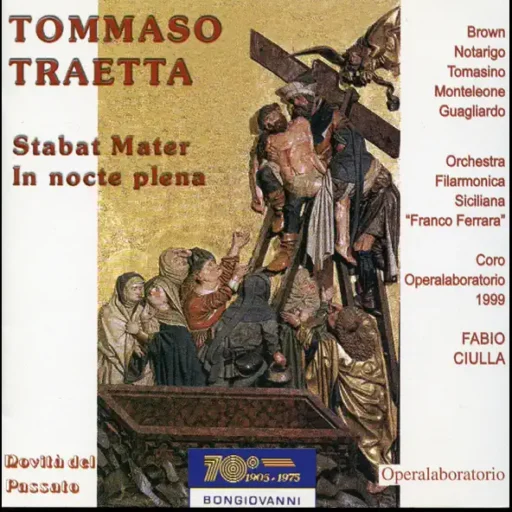
Tommaso Traetta (1727 – 1779) was born in Bitonto, Italy. He is predominantly known for his opera’s. He worked in Vienna, Mannheim, St.Petersburg and Venice. In his sacred works the influence of his teacher Durante can be seen. He combines contrapuntal skill with rich chromatics in a search for the expression of pain. He wrote several Stabat Mater compositions, two are described below. The 19th century composer Camillo de Nardis used themes from one of his Stabat Maters for an instrumental composition

